
Seeing that number drop into the 500s is a gut punch. You aren’t the first person to stare at a credit report and feel like you’ve been locked out of the financial system. It happens to anyone. A medical emergency, a job gap, or just a string of bad luck that piles up until it feels impossible to shake.
The panic usually kicks in when a car breaks down or a home repair turns up an unexpected bill. You need cash right now, but traditional banks tend to shut their doors the moment they see a low score. It’s a classic Catch-22: you need money to fix the life problems that ruined your credit, but you can’t get the money because of those same problems.
It isn’t a dead end, though. The market for alternative lending has grown because lenders are realizing that a FICO score doesn’t tell the whole story of whether someone can actually pay them back. They are starting to look at different data points instead of just one number.
If you’re navigating this right now, you might be looking for personal loans for poor credit to bridge the gap. The trick is to find a lender that actually looks at your current income and debt-to-income ratio, rather than just a three-digit number.
Navigating the High Cost of Quick Cash
Interest rates are the elephant in the room. When you have a low score, you’re essentially paying a premium for the risk the lender is taking. That’s just the math, and it doesn’t change because we wish it would.
For many online lenders, there’s a ceiling on what they can charge, but that ceiling is still high. According to LendingTree, a common cap for online lenders can be as high as 35.99%. That’s a massive amount of extra money to pay back over the life of a loan.
I once worked with a client, let’s call him Mike, who needed $5,000 to consolidate high-interest credit card debt. He thought he was being smart by taking a personal loan, but he didn’t realize that a 29% APR on a three-year loan meant he’d end up paying back way more than he originally borrowed. He was just moving the debt around, not actually getting rid of it.
You have to be honest about the math. If you take a high-interest loan to pay off lower-interest debt, you might make your situation worse in the long run even if it feels better this month. Always calculate the “total of payments” before you sign anything.
Ask yourself if the high interest is worth it. Is this fast funding going to save you from a late fee or a collection? If so, the interest might be worth the relief. If it’s for something non-essential, you’re likely making a mistake.
What Lenders Actually Look At Besides Your Score
People often think their credit score is the only thing that matters. It’s a big part of the puzzle, but it isn’t the whole picture. Lenders are getting more sophisticated in how they evaluate “risk.”
They mainly want to know two things: how much money you make and how much of it is already spoken for by existing bills. Your annual income is a huge factor. If you show a steady, reliable income stream, a lender might overlook a recent dip in your score.
They also look at the reason for the loan. Some lenders are more willing to work with someone borrowing to consolidate debt or handle a necessary home repair than someone borrowing for a vacation. The purpose of the loan can change your approval odds.
To get ready for an application, have these things on hand:
- Proof of income, like recent pay stubs or W-2s.
- An accurate list of your current monthly debt.
- A clear reason why you need the specific amount you’re asking for.
- Bank statements to prove your cash flow.
Lenders are increasingly using “alternative data” to help people build credit while they borrow. As noted by NerdWallet, some top lenders offer ways to help you build your credit score through the process of managing the loan itself. This is a massive advantage if you want to improve your financial standing long-term.
Comparing Your Actual Options
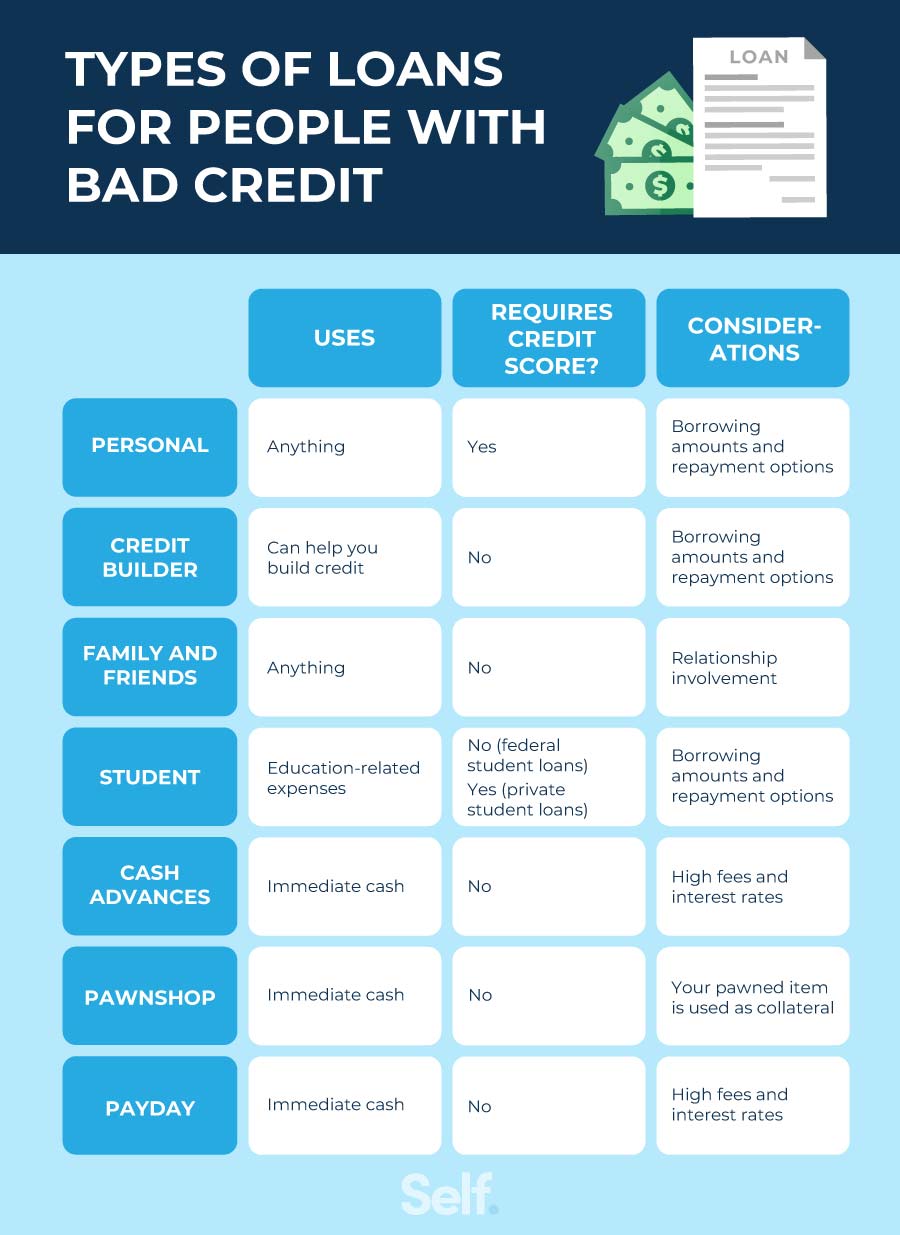
Not all bad credit loans are the same. Some are secured, meaning you have to put up something of value, like a car title or a savings account, as collateral. Others are unsecured, which means the lender is lending purely on your promise to pay them back.
Unsecured loans are safer because you won’t lose your car if you hit a rough patch, but they are much harder to get with bad credit. That’s why the interest rates on unsecured options are so much higher.
| Loan Type | Risk to You | Ease of Approval | Typical Interest Rate |
|---|---|---|---|
| Unsecured Personal Loan | Low (No collateral) | Harder with bad credit | Higher |
| Secured Personal Loan | High (Risk of losing asset) | Easier to qualify | Lower |
| Credit Builder Loan | Low | Very High | Very Low |
If you need a loan but don’t want to risk your car, look at credit builder loans. They work differently. You don’t get the cash upfront; the lender holds the money in a locked account, and you make payments toward it. Once the term is over, you get the money, and your credit score has hopefully jumped.
Check if there are lenders that specialize in your specific score range. Some focus specifically on scores under 580, which is a very different market than the “prime” lenders used by people with 700+ scores.
The Strategy for Moving Forward
Getting the loan is only half the battle. The real work starts when the money hits your account. If you use a high-interest loan to solve a problem, don’t create a bigger one in the process.
If you use funds for debt consolidation, you have to be disciplined. If you pay off a $3,000 credit card with a $3,000 personal loan, but then you spend that $3,000 on the credit card again, you’ve doubled your debt. That’s the trap.
I’ve seen people use personal loans to fix their credit by paying off collections. That’s a smart move if you do it right. By clearing those old debts, you stop the bleeding and give your score room to breathe. It’s a tactical move, not just a way to get cash.
Keep in mind that your debt-to-income ratio is always changing. Every time you take out a new loan, that ratio moves. If you plan to buy a house or a car in the next year, be very careful about adding new installment debt to your profile right now.
The best way to use a personal loan with bad credit is as a stepping stone, not a permanent crutch. Use the funds to fix the immediate crisis, and use the repayment schedule to prove to credit bureaus that you are a reliable borrower.
Finally, check your bank statements for “hidden” fees in your agreement, specifically regarding prepayment penalties. You want to be able to pay the loan off early without being charged extra for being responsible.
Good to know
Can I get a personal loan with bad credit?
Yes, many lenders specialize in bad credit loans, though you may face higher interest rates and lower borrowing limits.
What are the requirements for a bad credit personal loan?
Lenders typically require proof of steady income, a valid ID, and a bank account to verify your ability to repay the debt.
Will a personal loan for bad credit help improve my credit score?
Yes, making consistent, on-time payments can help build your credit history and improve your score over time.
Are there any risks to taking a high-interest personal loan?
The primary risk is the increased cost of borrowing due to high APRs, which can lead to a larger total debt burden.
